DIGITAL OPTIONS MECHANICS · OCTOBER 2026
Digital Options Strike Price: How Strike Levels Affect Returns
A different strike changes the price condition a Digital Options contract must satisfy. It can also change the profitability displayed before entry. Here is how to read those numbers without confusing the current market price, an offered return, and a completed trade.
Checked and written by Alex Vega · first-hand platform screenshots · 9 October 2026
What Is a Strike Price in Digital Options?
A strike price is a designated price level against which the relevant settlement price is assessed under a particular contract.
On a selectable-strike Digital ticket, the trader sees an asset, an expiry, a direction such as Higher or Lower, and one or more potential strike levels. When the option is accepted, its result depends on the condition defined in that contract. For a simple Higher condition, the settlement value must exceed the selected strike; for a Lower condition, it must fall below it.
Think of the strike as a threshold, not a target-profit slider. A price can rise after a trade is opened yet remain below a selected strike above the entry price. That is why the statement “the chart went up” is not enough to establish whether a strike-conditioned Higher contract met its terms.
Other short-duration products use an opening or reference price instead of a manually selectable strike. Names differ across providers. This guide concerns the selectable-strike workflow observed in IQ Option Digital and the strike-mode explanation in Exnova Digital. Product-name boundaries are covered separately in Digital Options vs Binary Options.
Current Price, Reference Price and Selected Strike
Current price
The most recent quoted price visible on the chart. It moves throughout the session, including while a purchase screen is open. It is a market-display value, not necessarily the final price used by the operator for settlement.
Reference price
Some products compare expiry with a reference value recorded around the opening or purchase event. Other products use a separately chosen strike. Check the specific product model before treating the reference and strike as interchangeable.
Strike price
A selectable level visible in a Digital Options ticket. It can sit above or below the changing current price. The selected level and direction together define what must occur by the relevant contract endpoint.
Changing the chart timeframe does not change the expiry or recorded strike of an already accepted contract. For the separate timing issue, see Digital Options expiry time.
Three Strike Levels, One Expiry: Worked Example
This educational example fixes the expiry and settlement price. It uses made-up price levels to illustrate the comparison logic, not broker quotes or trading results.
Assume a current price of 100.00. Imagine three separate Higher contracts that expire at the same moment, with strikes at 99.50, 100.00 and 100.50. At expiry, the hypothetical settlement price is 100.20.
Two conditions are satisfied because 100.20 is above their strikes. The highest strike is not satisfied because 100.20 is below 100.50. The market rose relative to 100.00, yet the highest-strike Higher condition still failed in this illustration.
The example deliberately contains no payout percentages. Whether an operator offers an order at each level, what percentage it displays, the source of its settlement price, and how equality is handled must come from the actual ticket and contract rules.
For a Lower condition, the inequality is reversed: the settlement value would need to be below the chosen strike.
| Chosen strike | Price at expiry | Is 100.20 above strike? | Higher condition |
|---|---|---|---|
| 99.50 | 100.20 | Yes | Satisfied |
| 100.00 | 100.20 | Yes | Satisfied |
| 100.50 | 100.20 | No | Not satisfied |
What if the numbers are equal? Equality is a separate contract-rule case. A strict “above” or “below” test is not met at equality, but that does not establish whether a particular provider treats the result as a loss, void or refund. Read the applicable product terms.
Why the Displayed Profitability Changes with the Strike
When a Digital platform offers multiple strikes, the relevant price condition and the displayed return belong to a particular ticket configuration. The direction matters: a Higher position above the current price asks the underlying to climb beyond a more distant threshold, while a Lower position below the current price asks it to reach the opposite side. The platform can show different returns for those directions, or make one quote unavailable in the current market state.
IQ Option’s official Digital Options guide describes selecting strike levels manually or using an automatic nearest-strike choice, and reports differing profitability across strike levels. The current underlying price, selected expiry, market quotes and time of observation may change while the user navigates the ticket. An observed change from one screenshot to the next therefore does not isolate strike as the only cause of a percentage change.
Distinguish quoted profit percentage before entry from the realized contract result. A 277% offer on the screen is not a 277% probability of winning, and it is not a result booked to the account. Likewise, moving farther beyond the strike after accepting a contract does not universally multiply a predetermined payout. Actual accepted contract specifications govern settlement, and educational descriptions of return can be less precise than product documentation.
Primary explanation: IQ Option’s official Digital Options guide (September 2026). It describes feature behavior; check relevant contract terms for settlement precision.
IQ Option Digital: What the Strike Ladder Shows
Two selected levels, same EUR/USD Digital instrument, $1,000 stake and 04:54 expiry. Captured 9 October 2026, about six seconds apart.
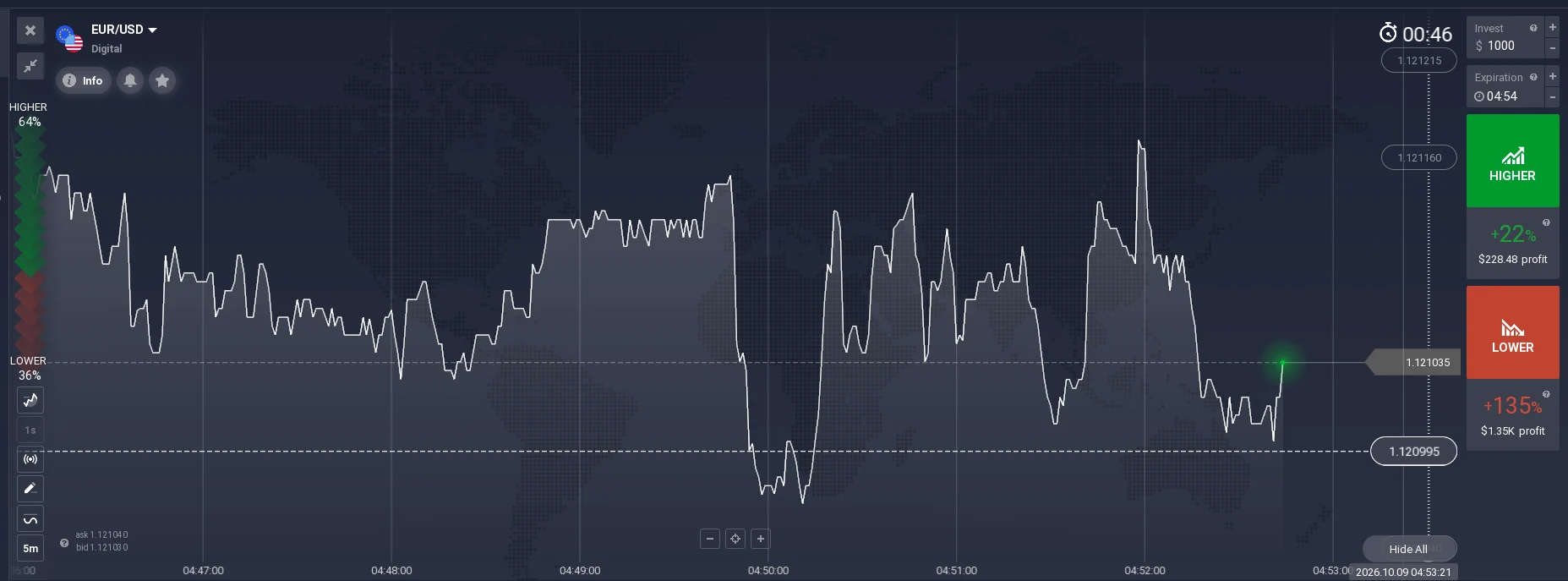
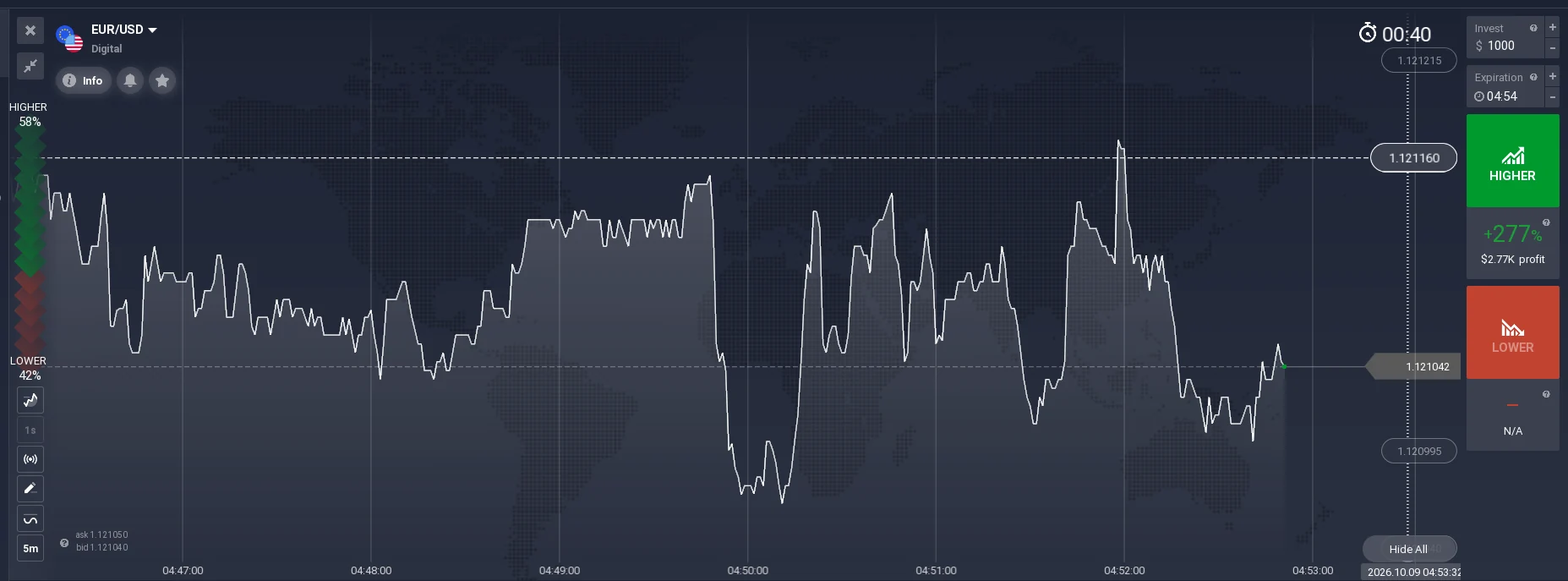
The lower strike at 1.120995 was below the current displayed price of 1.121035. At that moment the pre-entry ticket offered +22% for Higher and +135% for Lower. Six seconds later, the selected strike 1.121160 was above the displayed current price of 1.121042; the same expiry ticket showed Higher +277% and Lower N/A.
These images prove what the terminal displayed, not what was purchased. The market price and quote time changed between captures. The difference between +22% and +277% cannot be attributed to strike selection alone, and N/A does not mean Lower is permanently unavailable. Neither screenshot records a filled order or an outcome. The account type is not established by the images; these are described as pre-entry platform captures, not verified practice-account transactions.
Show the default-quote capture from the same sequence
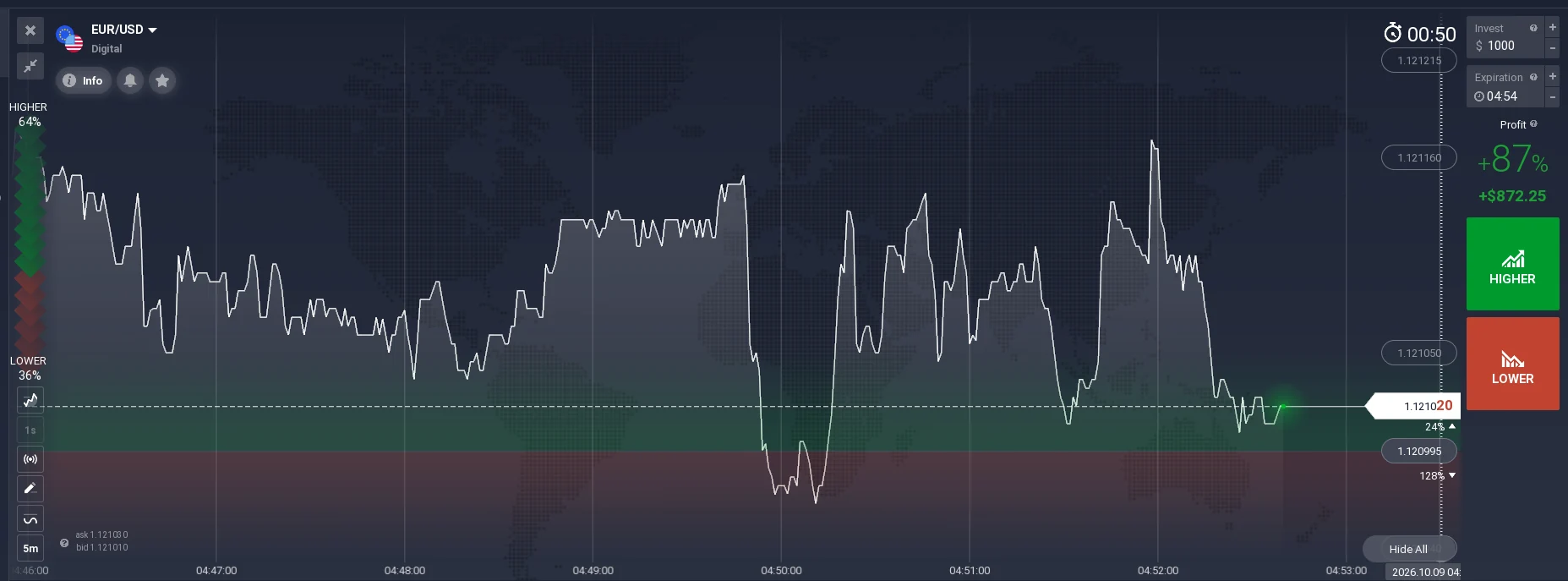
For the wider account and product investigation, see IQ Option Digital platform evidence.
Exnova Nearest Strike vs Current Price
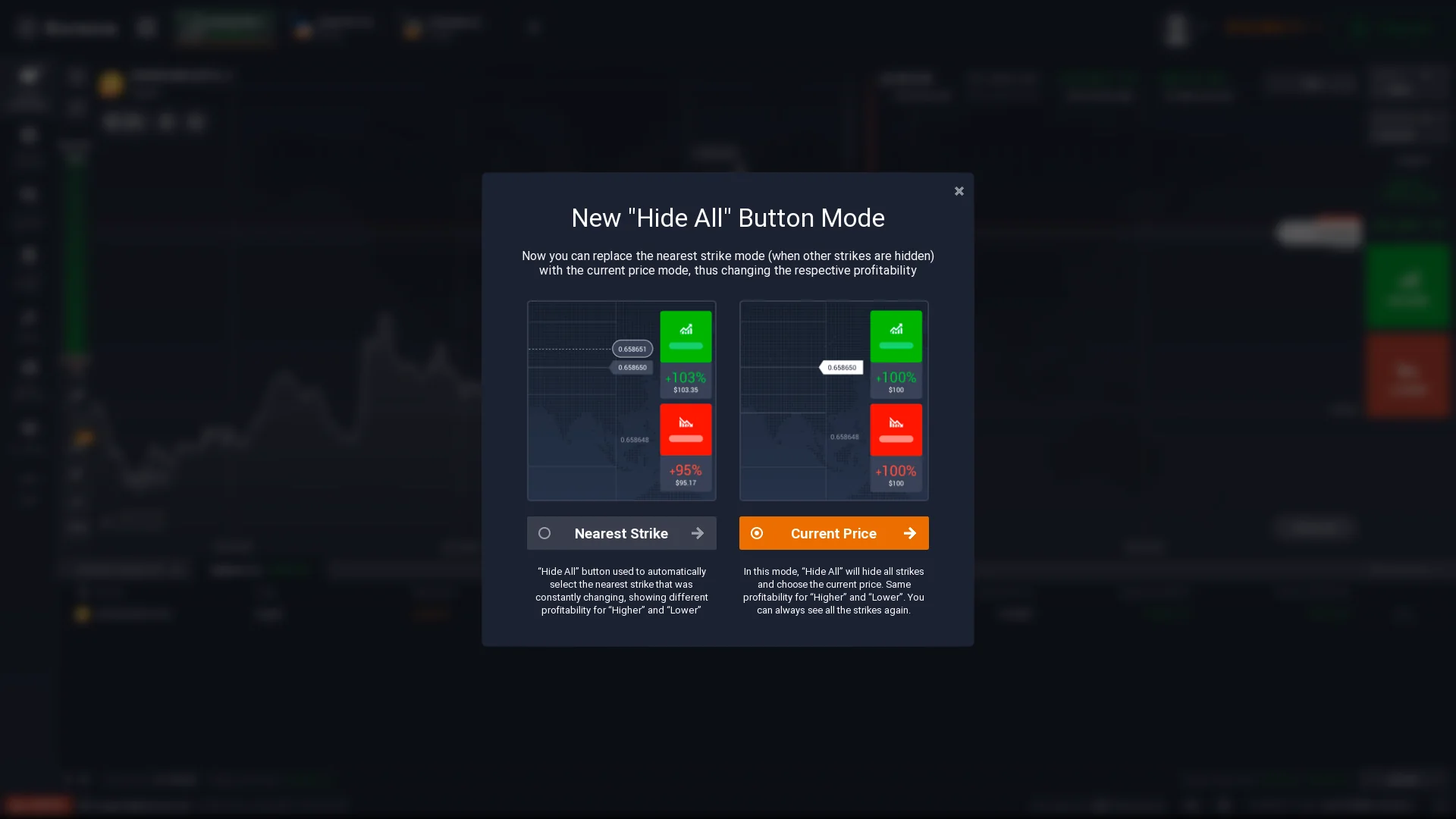
In Exnova Digital, the on-screen explanation for the “Hide All” mode describes how two presentation/selection states work. Its Nearest Strike description says the platform automatically selects the level closest to the current price, with direction-specific profitability displayed. Its Current Price explanation says other levels are hidden and the current price is used in the illustrated view.
The important nuance is that this is more than a label change in the explanation, but it is still not evidence of the strike that a particular submitted order recorded. The graphic inside the modal is demonstrative; it is not a verified live quote at one date and time.
Before comparing an Exnova ticket with IQ Option, distinguish what the screen is highlighting from what is ultimately accepted after placing an order. The broader Exnova product check also separates its Digital, Binary, Blitz and Margin products: Exnova platform evidence.
Expected Return, Early Sell and the Final Result
Expected Return
A displayed value associated with the stated expiry outcome or open position under the platform’s current presentation. It should not be read as money already realized or available to withdraw.
Return After Sell
A separate exit quotation, when the product supports early selling. It can change with the market and the time remaining. It is not automatically the same value as expiry return.
Recorded Result
The amount or outcome in the platform’s completed-position history after expiry or an actual early close. It belongs to the accepted contract and execution record, not to a pre-entry quote.
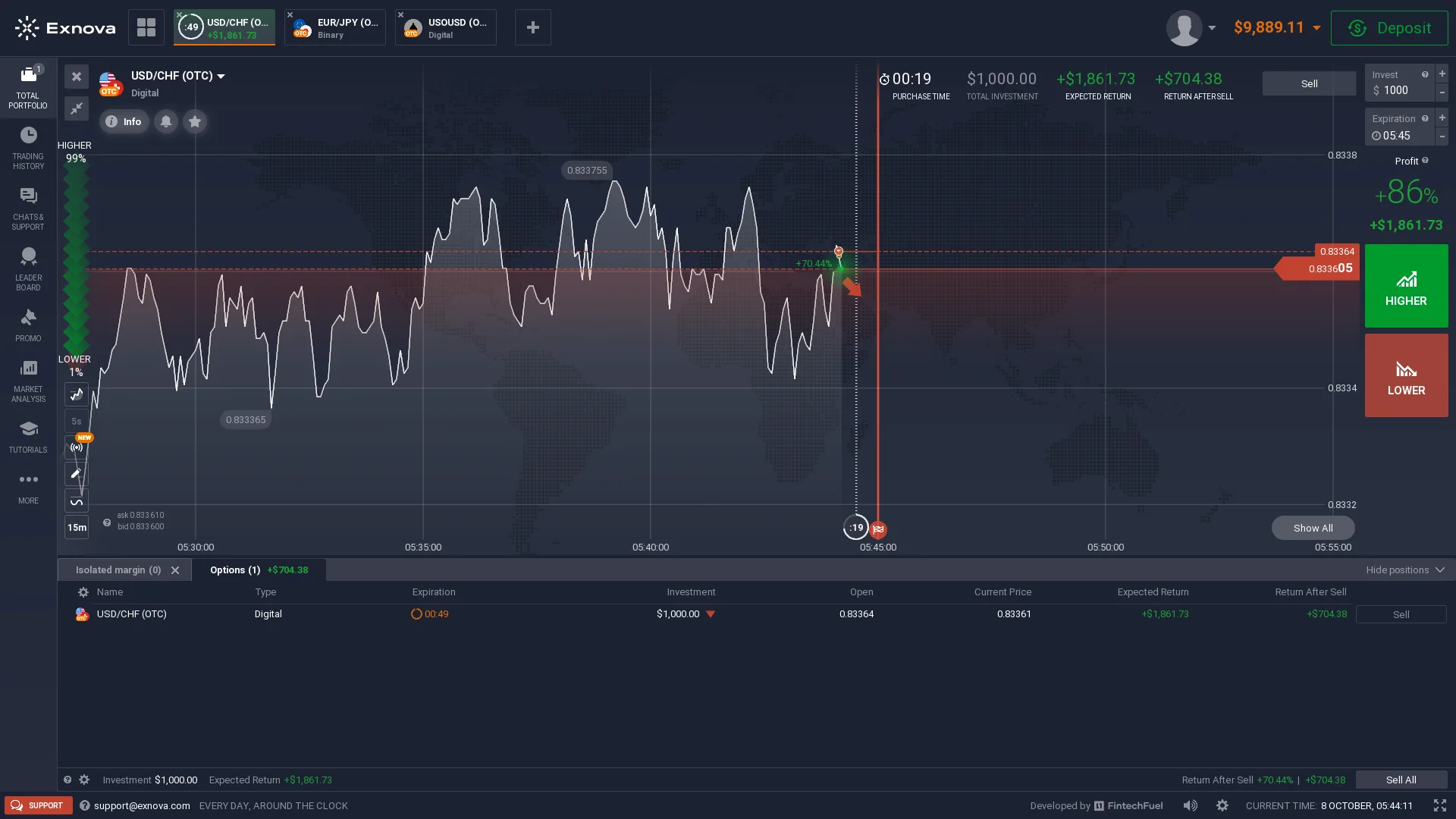
Our Exnova Digital demo capture records $1,000 Total Investment, +$1,861.73 Expected Return and +$704.38 Return After Sell. They appear together on the same open-position screen. That is direct evidence that the interface distinguishes the projected outcome from the present early-exit figure.
These three numbers do not establish what the position eventually earned. Nor do they establish a payout curve in which every additional fraction of price movement beyond the strike automatically adds profit. The accepted contract and actual closing method determine the result.
If checking an already settled or manually closed trade, read How to Verify a Digital Options Trade. That page addresses history, timestamps and settlement records rather than choosing a strike before entry.
What to Verify Before Reading a Strike Quote
The payout percentage in a current offer is useful input for contract arithmetic, but not a forecast of how frequently trades will win. For the mathematical relationship between a stated payout and break-even win rate, use the existing Payout & Break-Even Calculator.
Common Strike Price Misreadings
A higher payout is easier money
A larger conditional return says nothing by itself about the chance of reaching the threshold. It is an offer for that direction and setup, not a probability estimate.
Nearest means filled
Nearest Strike describes what the interface is selecting or showing at a given moment. Confirmed order details are the source of truth for an executed contract.
The settlement always follows one rule
Reference levels, rounding, equality, availability and early-close mechanics depend on the platform product. Do not transpose one provider’s conditions onto another.
Some traditional options articles discuss exercise prices, premiums, intrinsic value or Greeks. Those concepts are not automatically the rules of the short-duration Digital tickets photographed here. The relevant comparison is the actual ticket’s strike condition and documented settlement method, rather than a generic formula borrowed from another instrument.
Digital Options Strike Price FAQ
Is strike price the same as the current price?
Not necessarily. The current price is the market value shown on the chart. A selectable strike is a price level the contract tests at expiry; it can be above, below or near the current price. Check the accepted contract rather than assuming the two match.
Can I choose a different strike on IQ Option Digital?
The IQ Option Digital interface includes selectable strike levels. In our 9 October 2026 EUR/USD session we observed distinct pre-entry Higher/Lower quotes for selected strikes at 1.120995 and 1.121160 with the same listed 04:54 expiry.
Does a higher strike always mean a higher return?
No universal relationship can be inferred from strike alone. The quoted offer depends on direction, underlying price, expiry and changing market conditions. The larger displayed percentage does not mean the price condition is easier to meet.
What does Nearest Strike mean in Exnova?
The Exnova Digital interface explanation describes Nearest Strike as automatically selecting the strike closest to the current price and showing direction-specific profitability. Its Current Price view hides additional strike levels in that interface.
Does Current Price mode prove the strike in my executed order?
No. An interface explanation or pre-entry chart does not establish the exact terms accepted for a submitted order. Check the confirmed position or contract record for the applicable reference or strike.
Is Expected Return the same as Return After Sell?
No. Expected Return is the value displayed for the specified outcome at expiry, while Return After Sell reflects an early-exit quote when that function is available. The final booked settlement is another separate record.
What happens when the settlement price equals the strike?
Equality is a contract-specific case. Do not assume it is always a win or an automatic refund. The applicable product rules determine whether equality produces a loss, cancellation, returned stake or another result.
Interface findings: original IQ Option captures dated 9 October 2026 and Exnova captures dated 8 October 2026. General functionality: IQ Option official Digital Options guide. Financial examples explain contract conditions; they are not trade recommendations or assurances of profit. Trading these products can result in loss of the amount committed.

Independent web publisher working with documented platform interfaces and primary sources. This guide separates October 2026 observed quotes from illustrative strike-condition logic.