Weekend markets · OTC price context · five first-hand platform checks
OTC Weekend Trading: What Are You Actually Trading?
A regular market can be closed while a trading platform still shows a moving EUR/USD OTC chart. That does not automatically mean the normal weekday forex market is open, and the letters “OTC” do not tell you where every price comes from. The useful question is platform-specific: what instrument is this, when is it available, how does the platform describe its pricing, and what can you verify yourself?
Why Is EUR/USD OTC Moving on Sunday?
Because the platform is showing an OTC-labelled instrument that it makes available outside the usual market session. The ticker can still contain “EUR/USD”, but that does not establish that the screen is displaying the same live weekday EUR/USD price feed you would expect during the normal forex week.
Pocket Option’s current OTC schedule explicitly says OTC trading is available on weekends and when the usual asset is unavailable. IQ Option’s current OTC education describes a separate weekend/off-hours environment. Binolla likewise says its OTC instruments can be available when major markets are closed.
The practical consequence is simple: do not infer the price source from the symbol alone. First identify whether the asset is marked OTC, then check the schedule and the provider’s own explanation of how that OTC environment is priced.
What “OTC” Means Here — and What It Does Not Tell You
OTC means off-exchange
In finance, over-the-counter trading broadly refers to transactions that take place outside a centralized exchange. That general definition is useful, but it is only the starting point for understanding the OTC labels used inside retail trading platforms.
The platform label is product-specific
A retail platform can attach OTC to currency pairs, crypto, stocks, indices or other instruments and make them available outside the usual session. The provider’s schedule and contract terms determine what the user can actually trade.
The acronym does not reveal the feed
Seeing “OTC” does not by itself tell you whether the platform uses an internal model, liquidity-provider quotes or another methodology. That must come from a platform-specific disclosure or other evidence.
Keep the layers separate: the underlying/reference asset, the OTC-labelled contract shown by the platform, and the method used to produce the displayed price are related questions, not interchangeable answers. Crypto-based OTC instruments need a separate distinction: spot crypto can trade 24/7, so a weekend OTC label does not by itself mean the underlying crypto market is closed. For the contract-mechanics side, see Digital Options vs Binary Options.
OTC Price vs Regular Market Price
A familiar ticker can create false confidence. The better comparison is not “does the name look the same?” but “are these actually the same instrument, session and quote source?”
Typically follows the ordinary trading session and the provider’s normal market-data route for that asset.
Can remain available when the usual asset or exchange session is unavailable and may follow a provider-specific pricing arrangement.
Can change by asset and session. It is a contract condition shown by the platform, not proof of the underlying price source.
Depends on the contract rules shown for the platform product. The relevant reference is the platform’s own ticket and completed order record.
How Five Platforms Show and Describe OTC
We separate what we observed firsthand from what each platform says about weekend availability or price formation. A blank or “not confirmed” cell is intentional: it is better than filling an evidence gap with a universal claim.
| Platform | OTC observed first-hand | OTC trade / history tested | Weekend / off-hours source | What the platform says about price source |
|---|---|---|---|---|
| Quotex | Yes — OTC-labelled instruments in the checked asset selector | General demo workflow completed; current evidence does not isolate an OTC-specific completed history record | Not used as a source claim here | Not confirmed in our current source set |
| IQ Option | Yes — OTC-labelled assets were present in Digital | Yes — CARDANO (OTC) appears in our Trading History and was manually closed | Official weekend / off-hours OTC education | IQ Option describes internal pricing models / proprietary algorithms for its OTC environment |
| BinoDex | Yes — EUR/USD OTC in the checked Digital Options terminal | Yes — $10 EUR/USD OTC demo trade completed through history | Not used as a source claim here | Not confirmed in our current source set |
| Binolla | Yes — OTC-labelled instruments in the checked Fixed Time asset browser | Yes — $10 Bitcoin Cash OTC, one-minute demo trade completed through history | Official material describes OTC access outside normal market hours, including weekends | Binolla says OTC quotes are provided by special liquidity providers |
| Pocket Option | Yes — EUR/USD OTC in our current QT Demo evidence | Quick Trading demo workflow tested; current OTC screenshot documents ticket state and controls | Official OTC schedule says weekend / usual-asset-unavailable access | Not confirmed in our current source set |
IQ Option source context: official OTC material updated in 2026 describes a weekend/off-hours environment and says prices are generated through internal pricing models / proprietary algorithms.
Binolla source context: official underlying-asset education says its OTC quotes are provided by special liquidity providers when major markets are closed.
Pocket Option source context: the current OTC schedule states that OTC trading is available on weekends and when the usual asset is unavailable.
Weekend Availability Does Not Mean the Regular Market Is Open
A platform can keep an OTC-labelled instrument available while the ordinary exchange or weekday market session is closed. That is a feature of the provider’s product schedule; it is not evidence that the original market has reopened.
This distinction matters most with familiar labels such as EUR/USD OTC, NASDAQ-style OTC indices or stock-name OTC instruments. The asset name gives context, but the active contract, schedule and quote methodology determine what is on the screen.
It also explains why the most useful pre-trade question is not “is forex open?” but “what does this platform say this OTC instrument is using right now?”
Why OTC Charts Can Differ Between Platforms and TradingView
One chart may be the regular underlying or CFD feed while another is an OTC-labelled platform contract.
Providers can use different quote sources or pricing models. The same ticker text does not establish a shared feed.
Update intervals, timestamps, aggregation and server time can make short-duration charts look different even before considering price-source differences.
Where a provider uses an internal or platform-specific methodology, its OTC chart is not expected to be a tick-for-tick copy of another service.
A mismatch is a question, not a verdict. A different OTC chart does not automatically prove manipulation. The stronger evidence is the provider’s pricing disclosure, the actual ticket conditions, a timestamped screenshot and the completed order record used for settlement.
What Actually Determines an OTC Trade
OTC price context is only one layer. The result of a short-duration contract still depends on the conditions shown on the active ticket.
Check the complete label, including the OTC suffix.
Record the price visible on the ticket when the position is opened.
Shorter or longer timing changes the contract window, not the source of the price.
Direct Up/Down and selectable-strike products do not use identical ticket mechanics.
Treat it as session-specific and verify the current ticket rather than an old marketing maximum.
The completed record is evidence of the workflow and outcome used by that platform.
What We Can Verify — and What We Cannot
- OTC labels visible in the asset selector or trade ticket
- platform schedule and availability statements
- displayed payout / profitability at the time of a check
- expiry, direction, strike and other ticket controls
- order workflow and completed trade history
- a provider’s published explanation of its own pricing method
- where every individual price tick originated
- that two similarly named OTC assets use the same feed
- that a price difference proves manipulation or fairness
- that an observed payout remains fixed in later sessions
- that demo behavior predicts real-money results
- anything a provider has not disclosed and our evidence does not establish
This is the same evidence standard used across the site: first-hand interface checks for observable behavior, and primary sources for claims about pricing, company or product rules. See How We Verify.
Our First-Hand OTC Evidence
Three examples show different evidence levels: a completed OTC order, an OTC position in trade history, and a current OTC ticket. The five-platform matrix above contains the broader comparison.
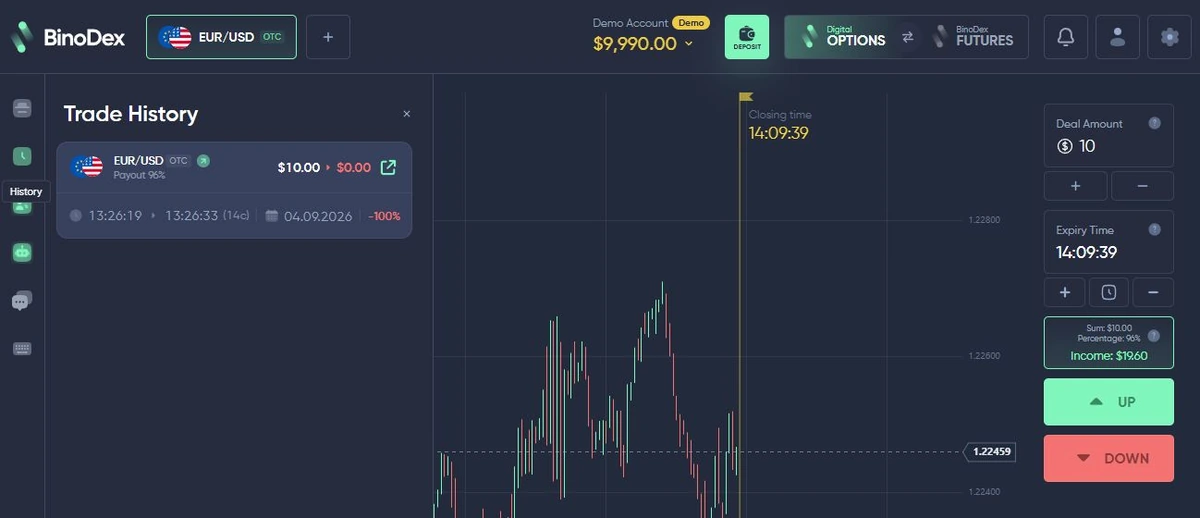
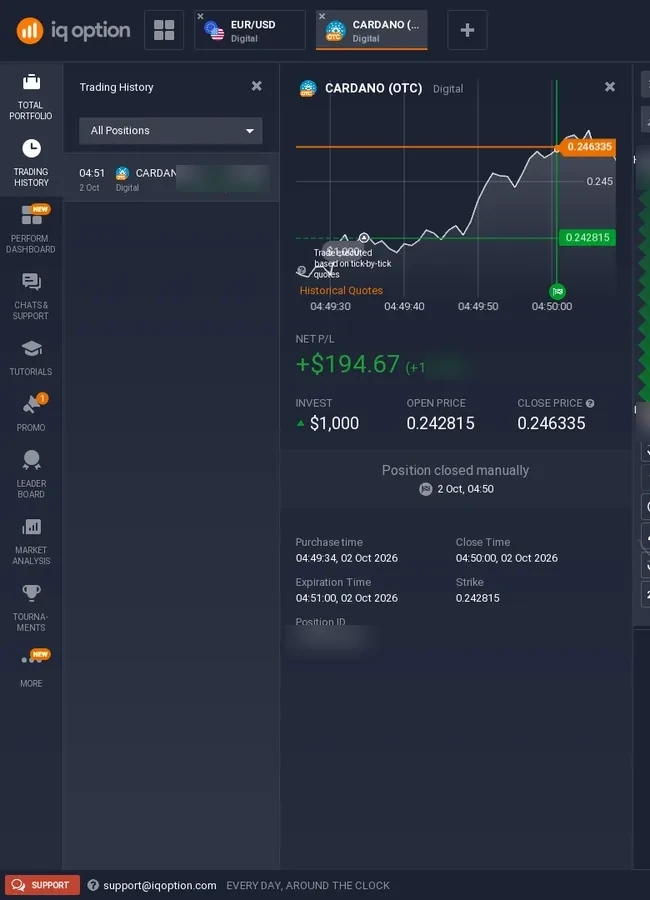
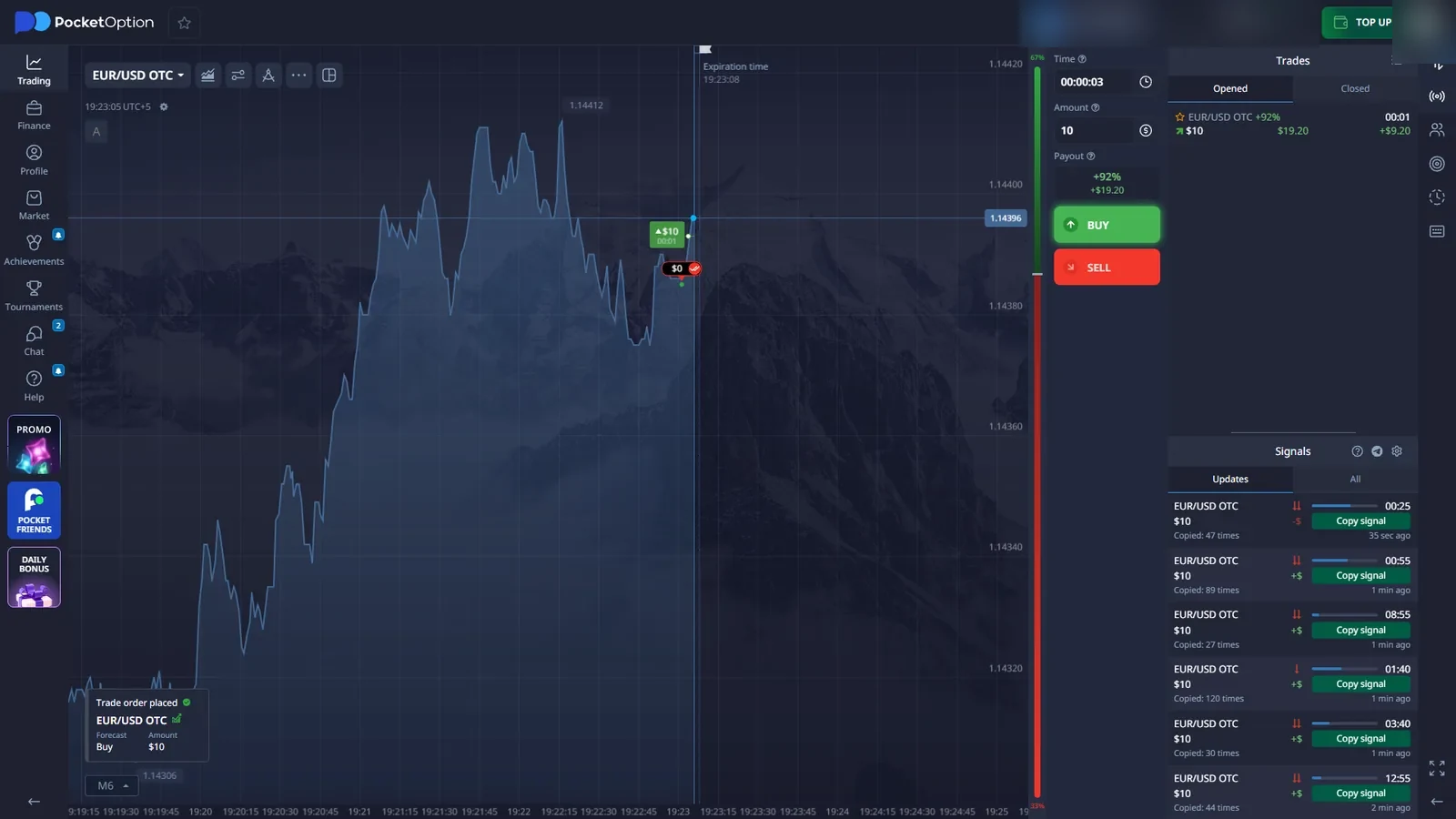
Other checked OTC-labelled tickets appear in our Tickz platform evidence and Exnova Blitz OTC evidence. These captures document OTC labels and ticket controls, not weekend availability for those specific sessions.
Quotex and Binolla are not omitted from the evidence set: our checked Quotex selector also contains OTC-labelled instruments, and our Binolla account includes a completed $10 Bitcoin Cash OTC demo trade. We keep the visual gallery compact rather than repeating every screenshot on one page.
Six Checks Before You Use an OTC Instrument
This is a verification checklist, not a trading strategy.
Do not treat EUR/USD and EUR/USD OTC as interchangeable just because the base ticker looks familiar.
Confirm whether the platform says the OTC instrument is available on weekends, holidays or only when the usual asset is unavailable.
Record exactly what the provider says. Do not fill an undisclosed mechanism with a claim copied from another platform.
Check the displayed price, expiry/trade time, direction or strike, amount and current payout/profitability before entry.
If demo is available, verify how the OTC trade opens, settles and appears in history. Do not treat a demo win as performance evidence.
Keep timestamps, screenshots and the completed history record before making a factual claim about a pricing or settlement discrepancy.
OTC Weekend Trading FAQ
Why does EUR/USD OTC move when the forex market is closed?
Because EUR/USD OTC is a platform-specific OTC-labelled instrument that can remain available outside the usual EUR/USD market session. The name references EUR/USD, but the price source and trading schedule must be checked for the specific platform rather than assumed from the ticker alone.
Is EUR/USD OTC the same as regular EUR/USD?
Not automatically. The two labels can reference the same underlying currency pair, but an OTC instrument may use a different schedule, price source or platform methodology. Treat the current OTC contract as its own instrument until the provider explains how it is priced and settled.
Who sets the price of an OTC instrument?
It depends on the platform. IQ Option describes internal pricing models and proprietary algorithms for its weekend OTC environment. Binolla says its OTC quotes are provided by special liquidity providers. For Quotex, BinoDex and Pocket Option, our current evidence confirms OTC-labelled instruments but does not justify assigning either of those pricing models to every OTC tick.
Why can an OTC chart differ from TradingView or another platform?
A chart can differ when the instruments use different price feeds, update timing, aggregation or platform-specific pricing methods. A matching symbol does not prove that two services are using the same market or quote source. Compare the provider disclosures and contract conditions before drawing a conclusion.
Does a different OTC price prove that a platform is manipulating the chart?
No. A price difference by itself does not prove manipulation. It tells you that the compared charts may not be using the same instrument, source or methodology. A stronger check is to ask what the platform says about the quote source, settlement rule and trading conditions and then preserve first-hand evidence of the ticket and completed history.
Can I check an OTC instrument in a demo account first?
Where a platform provides demo access, it can be useful for checking the OTC label, schedule, ticket controls, displayed payout or profitability and how a completed order appears in history. Demo evidence can document platform workflow, but it does not prove future real-money results, withdrawal performance or the fairness of every price tick.

Alex is the independent web publisher behind DigitalOptions.co. He checks trading interfaces, demo workflows, order history, payment screens and primary sources, and separates first-hand observations from platform claims when the evidence level is different.