Payout & Break-Even Win Rate Calculator
Enter the stake and the displayed payout as profit %. The calculator shows what a standard win or loss means mathematically and the win rate required to offset full-stake losses at that payout.
It does not estimate your probability of winning. It does not recommend a stake, predict profit or tell you whether to trade.
The break-even calculation assumes a losing trade loses the full entered stake and a winning trade returns the stake plus the displayed payout. Fees, refunds, early exits or other contract rules can change the result.
Refunded / tied trades are outside this two-outcome calculation.
How the Payout & Break-Even Calculation Works
Profit if win
stake × payout / 100A $10 stake at an 80% payout produces $8 potential profit if the standard winning expiry condition is met.
Amount at risk
stakeThe basic model assumes the full entered stake is lost when the standard losing expiry condition occurs.
Total return
stake + profitThe stake is returned together with the profit after a standard winning result. $10 + $8 = $18.
Break-even win rate
100 / (1 + payout / 100)At an 80% payout the threshold is 55.56%, before any different payoff rules or other costs.
What Does the Displayed Payout Percentage Mean?
For this calculator, payout means potential profit as a percentage of the stake. It does not mean the total percentage returned after a winning result.
If the platform shows a $10 stake and the standard winning result would return $18 in total, the profit is $8. The correct calculator input is therefore 80%. Entering 180 would double-count the returned stake and produce the wrong break-even figure.
Platforms do not always use the same label. Our current evidence set includes terms such as payout, profitability, percentage and displayed return. The label matters less than the underlying payoff: identify how much profit the displayed percentage represents on the entered stake.
Break-Even Win Rate by Payout
These values use the same two-outcome assumption as the calculator: full-stake loss on a losing result and stake plus the displayed profit percentage on a winning result.
| Displayed payout | Break-even win rate | Example profit on $10 stake | Total return after win |
|---|---|---|---|
| 60% | 62.50% | $6.00 | $16.00 |
| 70% | 58.82% | $7.00 | $17.00 |
| 75% | 57.14% | $7.50 | $17.50 |
| 80% | 55.56% | $8.00 | $18.00 |
| 85% | 54.05% | $8.50 | $18.50 |
| 90% | 52.63% | $9.00 | $19.00 |
| 95% | 51.28% | $9.50 | $19.50 |
| 120% | 45.45% | $12.00 | $22.00 |
A lower mathematical break-even threshold does not mean a trade is more likely to win. The calculator changes only the payoff arithmetic; it does not estimate win probability.
Where Do I Find the Displayed Payout?
Use the current number shown for the exact asset and contract setup. Payouts can change by asset, expiry, strike or session, so a screenshot is evidence of what we observed — not a permanent rate.
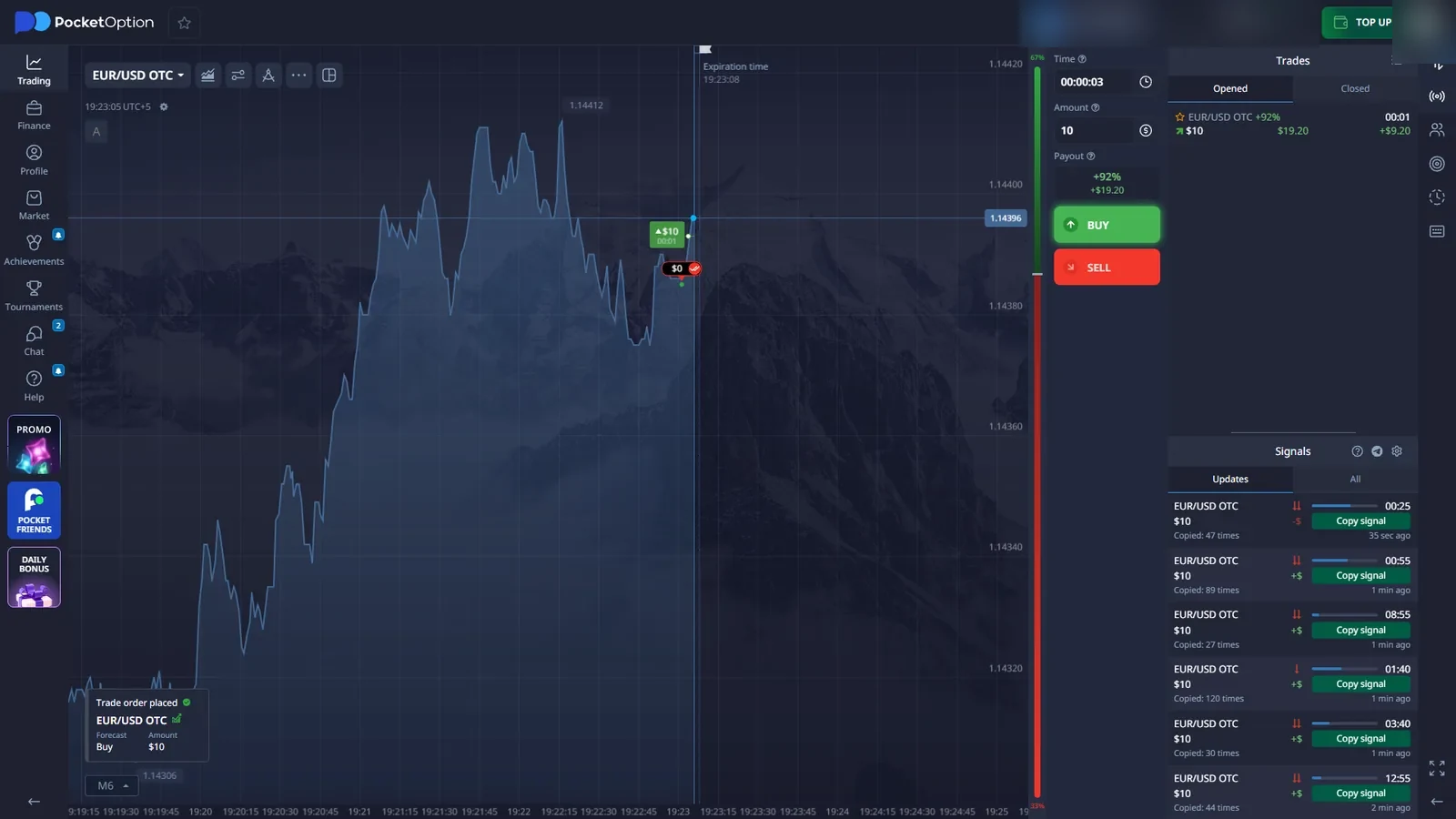
Payout + total-return relationship is visible
Our current QT Demo capture shows a $10 amount, +92% payout and $19.20 total displayed return. That is the exact distinction the calculator needs: the input is 92, not 192.
Read our Pocket Option platform check →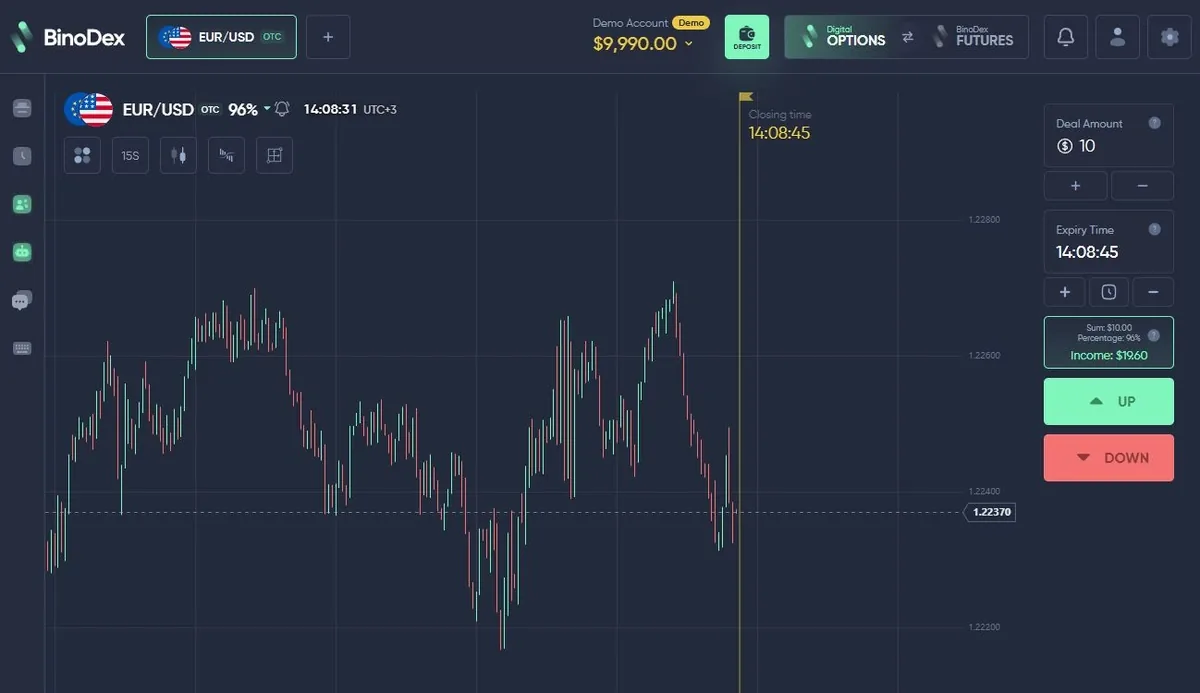
Use the percentage on the active ticket
The checked Digital Options session displayed 96% beside the selected EUR/USD OTC instrument and a $10 deal amount. That percentage was session-specific and should not be treated as a fixed platform rate.
Read our BinoDex platform check →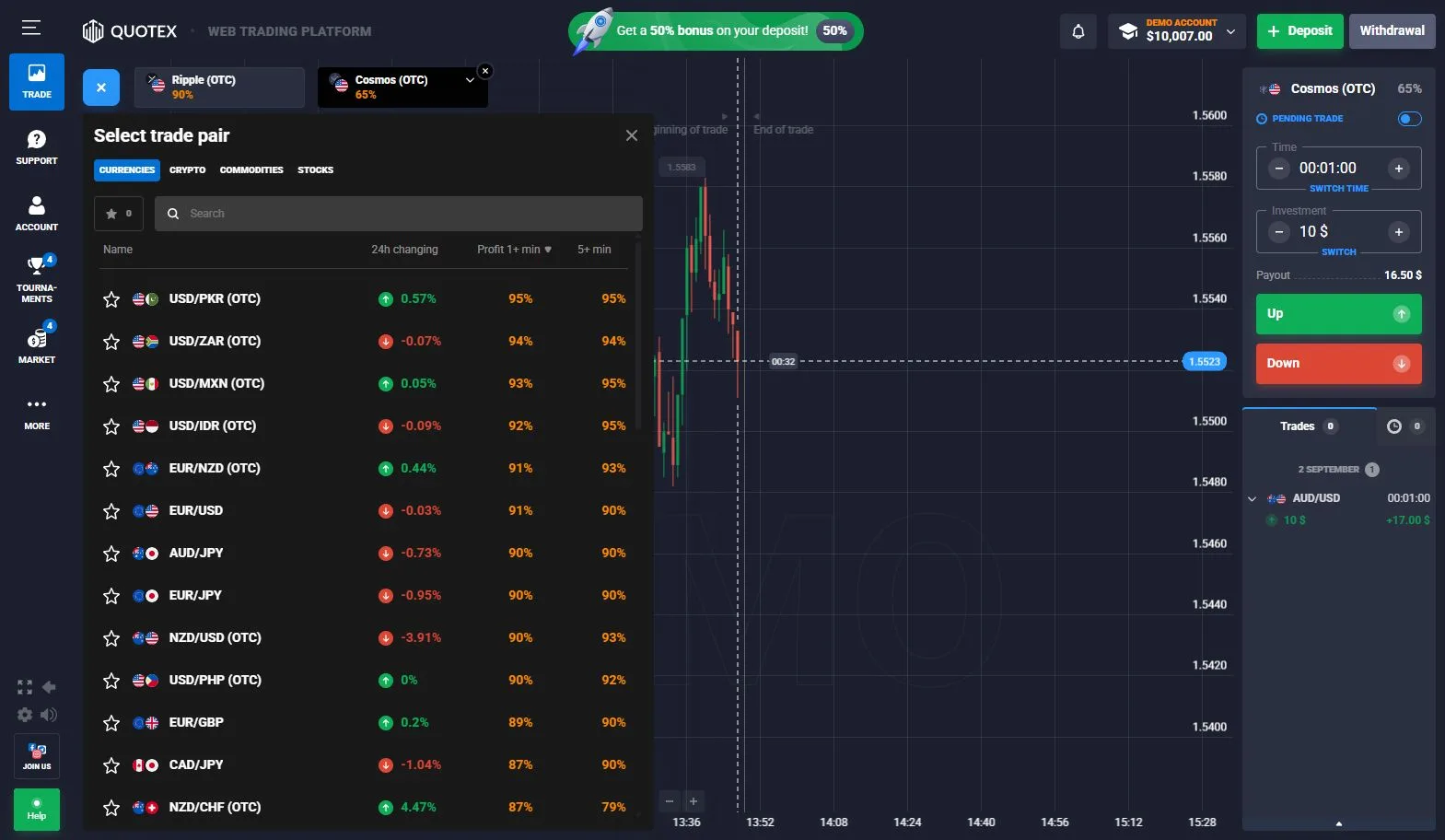
Different assets can show different payouts
Our Quotex capture shows multiple instruments with different percentage values in the same session. The practical input is the payout attached to the contract you are actually configuring, not a marketing maximum remembered from another page.
Read our Quotex platform check →Two interfaces where the simple payout number needs context
IQ Option Digital and Binolla both fit the standard payout arithmetic at ordinary expiry, but their interfaces show why the calculator must stay tied to the exact contract setup rather than a permanent platform-wide percentage.
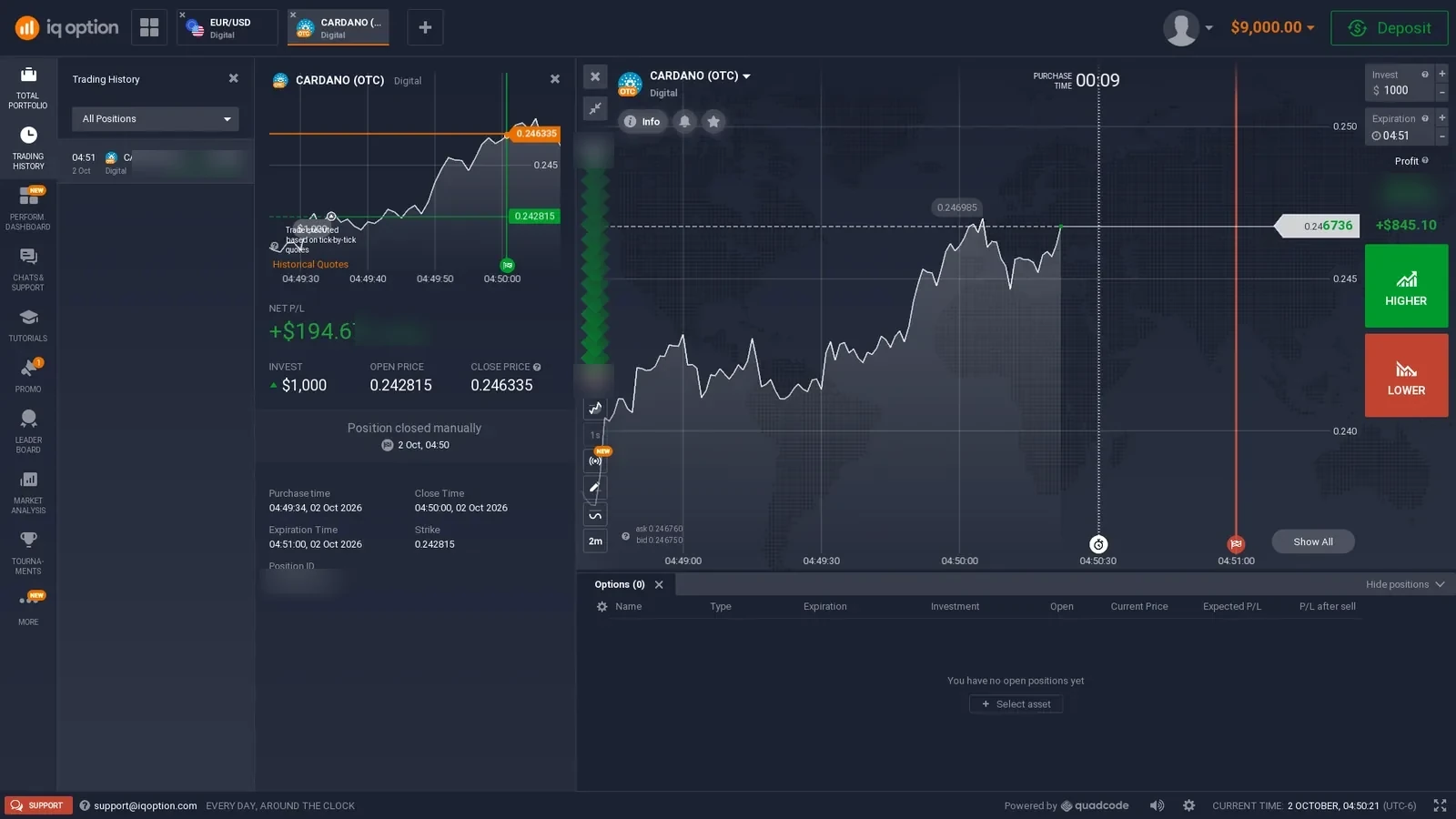
Our evidence shows the Digital contract, selected strike and a position recorded as Position closed manually. The base calculator therefore applies to the standard expiry payoff only; an Early Sell produces a different realized P/L.
Read our IQ Option platform check →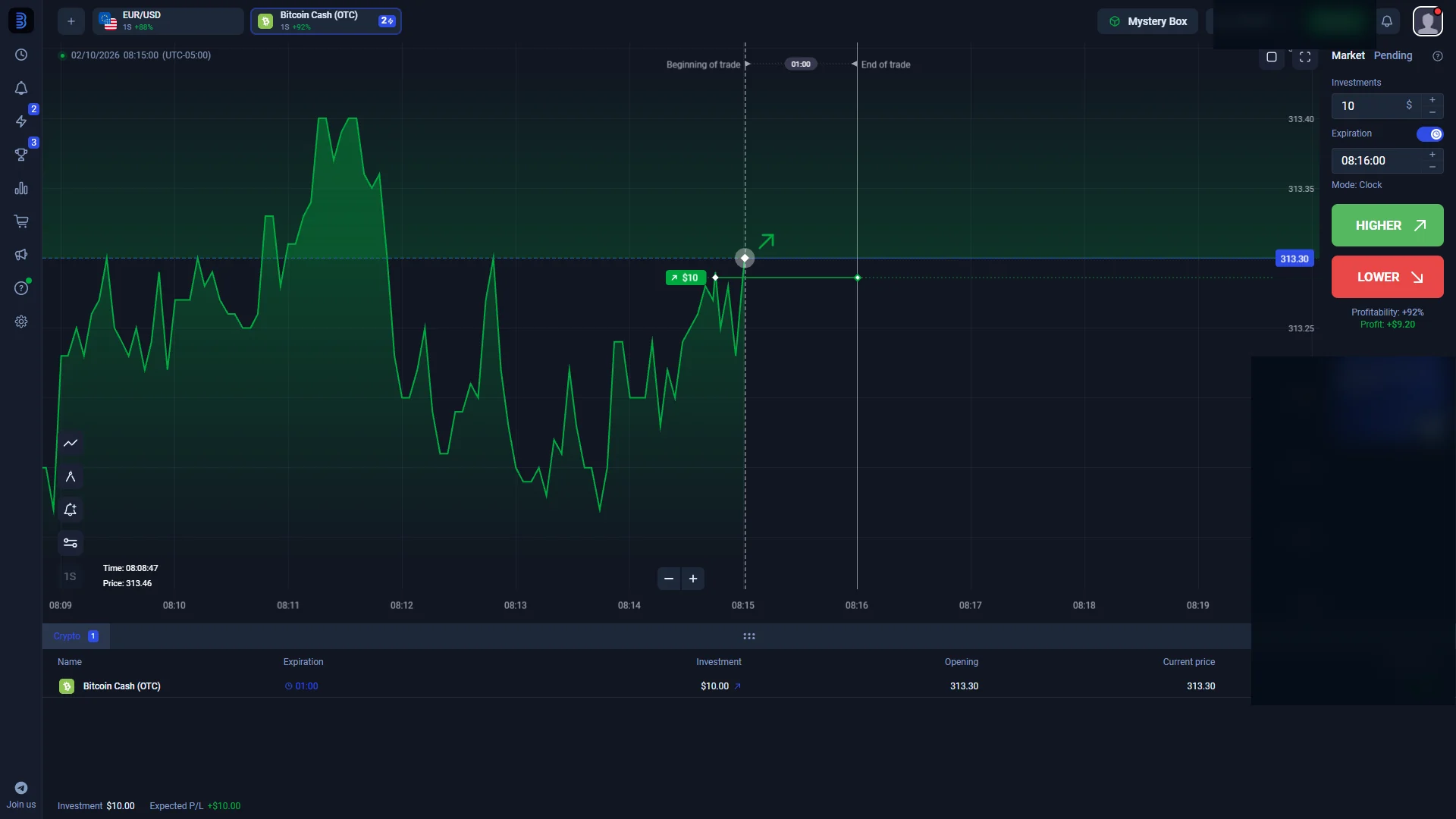
Our checked ticket shows a $10 investment, +92% profitability and +$9.20 profit. For that standard expiry setup, the calculator input is 92 — not the combined stake-plus-profit return.
Read our Binolla platform check →Does the Same Formula Apply to Every Platform?
The same arithmetic can apply to the standard win/loss payoff, but the displayed label and edge-case rules are not identical. This table describes the scope of the calculator rather than ranking the platforms.
| Platform | Displayed value we use | Standard expiry model | Important boundary | Base formula? |
|---|---|---|---|---|
| Quotex | Payout / potential return shown for the active setup | Stake + profit on win; stake lost on ordinary loss | Equality can return the stake | Yes, for win/loss |
| IQ Option Digital | Displayed profitability / payout offer for the selected strike | Invested amount + profit on correct expiry result; invested amount at risk on incorrect result | Selectable strikes; equality with strike and Early Sell require separate treatment | Yes, for standard expiry only |
| BinoDex | Displayed payout on the active Digital Options ticket | Stake + displayed profit on standard win; stake at risk on standard loss | Tie/void treatment not established by the source set used for this calculator | Yes, for the standard two-outcome case |
| Binolla | Payout / profitability as profit % of investment | Investment + profit on win; full investment lost on ordinary loss | Equality/refund and early-close rules can change the realized payoff | Yes, for ordinary expiry |
| Pocket Option QT | Displayed payout on the Quick Trading ticket | Fixed margin + payout on win; fixed margin at risk on ordinary loss | Equality can return the fixed margin | Yes, for win/loss |
Source hierarchy: first-hand interface evidence is used for what the ticket actually displays. Contract mechanics rely on the relevant platform documentation. For IQ Option Digital, payout/loss mechanics are interpreted from the specific Digital Options KID together with our current interface evidence; Early Sell remains outside the basic formula.
Refunds, Ties and Early Exit: When the Simple Formula Changes
Tie / equality
Do not assume one universal treatment. Some standard products can return the stake when settlement equals the reference value, while another product may define equality against its selected strike differently. A returned stake is neither the full loss nor the standard profit outcome used by the calculator.
Early Sell / early close
An early-close value can be lower or higher than the amount implied by the final expiry payoff. We directly observed manual Early Sell in IQ Option Digital. That realized P/L belongs outside this two-outcome calculator.
Fees or special rules
If a contract adds a fee, rebate, refund, promotion, risk-free mechanic or another payoff rule, use the calculator only to understand the basic displayed-payout relationship. The actual account result can differ.
It proves the arithmetic of the numbers you enter under the stated assumptions. It does not prove that a platform will offer the same payout later, that a trade will win, that a demo and real account will behave identically, or that a particular platform is suitable for you.
For evidence boundaries between practice and funded accounts, see Demo Account vs Real Account. For product naming and contract-mechanics differences, see Digital Options vs Binary Options.
Payout & Break-Even Calculator FAQ
What does an 80% payout mean?
In the standard two-outcome model used by this calculator, an 80% displayed payout means the potential profit is 80% of the stake. A $10 stake would therefore produce $8 potential profit and $18 total return after a winning expiry result.
What win rate breaks even at an 80% payout?
The mathematical break-even win rate is 55.56% when a losing trade loses the full stake and a winning trade returns the stake plus 80% profit. Refunds, ties, early exits or different contract rules can change the realized result.
Is payout percentage the same as probability of winning?
No. The displayed payout is a payoff figure, not a probability estimate. An 80% payout does not mean the platform is saying the trade has an 80% chance of winning.
Can the payout entered in the calculator be higher than 100%?
Yes. Some contract configurations can display potential profit above 100% of the stake. Enter the profit percentage shown for the specific contract, not the total amount returned after a win.
How are ties, refunds and early exits handled?
They are outside the basic two-outcome calculation. Platform rules differ: some equality outcomes can return the stake, while other products can treat equality differently. Early Sell or early-close values can also create a payoff that is different from the standard expiry result.
Does this calculator predict trading profit?
No. It only converts the stake and displayed payout into arithmetic results and the theoretical break-even win rate for the stated two-outcome assumptions. It does not estimate the probability of winning or predict future performance.

Alex checks platform interfaces, product labels, demo workflows, payout displays and primary-source documentation for DigitalOptions.co. This calculator is limited to arithmetic based on user-entered values and documented contract boundaries.